Bradford City Water Authority

BRADFORD  CITY
WATER  AUTHORITY
28 Kennedy Street, Bradford, Pennsylvania 16701


2008 Consumer Confidence Report
For the period January 1 - December 31, 2008

Este informe contiene informacion muy importante sobre su agua de beber.  Traduzcalo o hable con alguien que lo entienda bien  (This report contains very important information about your drinking water.   Translate it, or speak to someone who understands it.)


INTRODUCTION


We're pleased to present to you this year's annual drinking water quality report.  Our primary water source is the Heffner surface water reservoir, with secondary backup water sources of the Marilla and Gilbert surface water reservoirs.  All water supplied to our system originates from the protected lands of the Bradford Watershed.  A Source Water Assessment of our sources was completed in 2004 by the PA Dept. of Environmental Protection (PADEP).  The Assessment has found that our sources are potentially most susceptible to transportation corridors, stormwater runoff, and oil & gas wells.  Overall, our sources have very little risk of any significant contamination.  Summary reports of the Assessment are available by writing to the BCWA office, 28 Kennedy St., Bradford, PA  16701, and will be available on the PADEP website at www.dep.state.pa.us (Keyword: "source water").  Complete reports were distributed to municipalities, water suppliers, local planning agencies and PADEP offices.  Copies of the complete report are available for review at the PADEP Meadville Office, Record Management Unit at 814-332-6945.


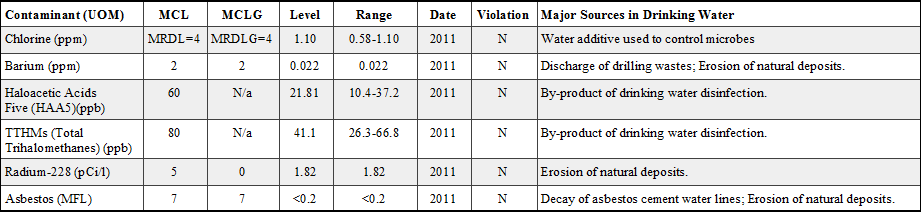
Bradford City Water Authority routinely monitors for contaminants in your drinking water according to Federal and State laws. This table shows the results of our monitoring for the period of January 1st to December 31st, 2008.   The State allows us to monitor for some contaminants less than once per year because the concentrations of these contaminants do not change frequently.  Some of our data is from prior years in accordance with the Safe Water Drinking Act.  BCWA received no violations for water quality or exceedance of MCLs for 2008.


DEFINITIONS


I
n this table you will find many terms and abbreviations you might not be familiar with. To help you better understand these terms we've provided the following definitions:

Parts per million (ppm) - one part per million (corresponds to one minute in two years or a single penny in $10,000).
Parts per billion (ppb) - one part per billion (corresponds to one minute in 2,000 years, or a single penny in $10,000,000).
Picocuries per liter (pCi/l) - picocuries per liter is a measure of the radioactivity in water.
Nephelometric Turbidity Unit (NTU) - nephelometric turbidity unit is a measure of the clarity of water. Turbidity in excess of 5 NTU is just noticeable to the average person.
Action Level (AL) -  the concentration of a contaminant which, if exceeded, triggers treatment or other requirements which a water system must follow. 

Treatment Technique (TT) - A treatment technique is a required process intended to reduce the level of a contaminant in drinking water.

Maximum Contaminant Level (MCL)-  The highest level of a contaminant that is allowed in drinking water.  MCLs are set as close to the MCLGs as feasible using the best available treatment technology.

Maximum Contaminant Level Goal (MCLG) - The level of a contaminant in drinking water below which there is no known or expected risk to health.  MCLGs allow for a margin of safety.
Maximum Residual Disinfectant Level (MRDL) - The highest level of a disinfectant allowed in drinking water.  There is convincing evidence that addition of a disinfectant is necessary for control of microbial contaminants.
Maximum Residual Disinfectant Level Goal (MRDLG) - The level of a drinking water disinfectant below which there is no known or expected risk to health.  MRDLGs do not reflect the benefits of the use of disinfectants to control microbial contamination.

WATER MONITORING RESULTS

Contaminant
(UOM)

Violation

Y/N

Highest Level

Range

MCL

MCLG

Major Sources in Drinking Water

MICROBIOLOGICAL CONTAMINANTS

1.  Turbidity (NTU)

N

0.16

100%(a)

TT

n/a

Soil runoff.

RADIOACTIVE CONTAMINANTS

2. Alpha emitters (pCi/l)

N

0.2

0.2

15

0

Erosion of natural deposits.

INORGANIC CONTAMINANTS

3.  Barium (ppm)

N

0.020

0.020

2

2

Discharge of drilling wastes; Discharge of metal refineries; Erosion of natural deposits.

4.  Fluoride (ppm)

N

0.19

0.19

2

2

Erosion of natural deposits; Discharge from fertilizer and aluminum factories.

5.  Nitrate (ppm)

N

0.21

0.21

10

10

Runoff from fertilizer use; Leaching from septic tanks, sewage; Erosion of natural deposits.

LEAD & COPPER RULE

6.  Lead (ppb)

N

4.8

(b)

AL=15

0

Corrosion of household plumbing systems; Erosion of natural deposits.

7.  Copper (ppm)

N

0.018

(c)

AL=1.3

1.3

Corrosion of household plumbing systems; Erosion of natural deposits.

DISINFECTION BYPRODUCTS (DBPs), BYPRODUCT PRECURSORS, AND DISINFECTANT RESIDUALS

8.  Haloacetic Acids
     (HAA5) (ppb)

N

14.6

0.0-14.6

60

60

By-product of drinking water disinfection.

9.  TTHMs (Total
    trihalomethanes)(ppb)

N

87.0

25.0-87.0

80

80

By-product of drinking water disinfection.

10. Total Organic
       Carbon (ppm)

N

1.1

0.7-1.1

TT

n/a

Naturally present in the environment..

11.  Chlorine (ppm)

N

1.2

0.2-1.2

MRDL
=4

MRDLG
=4

Water additive used to control microbes.

  1. In the year 2008, 100% of turbidity samples met the turbidity limits.
  2. One of the 30 samples collected exceeded the action level for lead.
  3. None of the 30 samples collected exceeded the action level for copper.

CONCLUSION


We're proud that your drinking water meets or exceeds all Federal and State requirements. We have learned through our monitoring and testing that some contaminants have been detected.  Drinking water, including bottled water, may reasonably be expected to contain at least small amounts of some contaminants.  The presence of contaminants does not necessarily indicate that the water poses a health risk. More information about contaminants and potential health effects can be obtained by calling the Environmental Protection Agency's Safe Drinking Water Hotline at 1-800-426-4791.

Some people may be more vulnerable to contaminants in drinking water than the general population. Immuno-compromised persons such as persons with cancer undergoing chemotherapy, persons who have undergone organ transplants, people with HIV/AIDS or other immune system disorders, some elderly, and infants can be particularly at risk from infections. These people should seek advice about drinking water from their health care providers. EPA/CDC guidelines on appropriate means to lessen the risk of infection by cryptosporidium and other microbiological contaminants are available from the Safe Drinking Water Hotline (800-426-4791). 

PAST, PRESENT & FUTURE


Over the past two decades, over 20 million  dollars has been invested in improvements to the Bradford water system.  During this time frame, the system has seen positive growth and expanded its service to include Bradford, Foster, and Lafayette Townships.  Service now extends as far south as the Bradford Regional Airport.  During this coming year we shall be implementing 2.5 million dollars of significant upgrades to our water treatment plant.  These improvements shall result in environmentally friendly methods to handle and dispose of residual waste created by the water filtration process.  During 2008 the 5 million dollar rehabilitation of Marilla Reservoir was completed.  We shall also be continuing to rehabilitate our other water impoundments as well as replace aged infrastructure and components. 

We at the Bradford City Water Authority work around the clock to provide top quality water to every tap. We ask that all our customers help us protect our water sources, which are the heart of our community, our way of life and our children's future.

If you have any questions about this report or concerning your water utility, please contact Kim  Benjamin at the BCWA office,
814/362-3004.
We want our valued customers to be informed about their water utility. If you want to learn more, please attend any of our regularly scheduled meetings held on the fourth Tuesday of the month at 12:00pm in the conference room of the Bradford City Water Authority  office, 28 Kennedy Street, Bradford, PA  16701.

The Staff of the Bradford City Water Authority

Home Page ** History ** Watershed ** Treatment Plant ** Rates ** Legal Ads
Tips ** Flood of 99 ** CCR Report ** Lead ** Thermal Expansion ** Contact Us